Here is How You Can Cut Your Grocery Bill Too-FREE PDF Meal Plan Sheets
There was a time when I desperately needed to learn how to cut my grocery bill in half. Not because I fancied trying a budgeting challenge or wanted to see if I could survive on beans for a month. I needed to reduce our grocery spending because I was in debt, and every penny I could save brought me one step closer to getting my finances back under control.
Over the following year, I cut our grocery budget in half, from around €100 a week to €50 a week. Those weekly savings added up to around €2,600 over the course of a year, helping me pay off roughly a quarter of my debt.
People often assume that cutting your grocery budget means eating badly. I certainly had plenty of people tell me that online over the years. They imagined we’d be living on instant noodles and processed food and that our family would end up unhealthy. For us, the opposite happened.
We cooked even more from scratch, ate more vegetables, wasted less food and relied far less on convenience foods. Looking back now, I honestly think it was one of the healthiest years we’d had as a family.
If you stopped me today and said, “Ruth, I don’t need a long article. Just tell me the five things you’d do first if you needed to slash your grocery bill quickly,” this article contains exactly what I’d tell you.
Before we get started, why not sign up for my newsletter? You’ll receive practical money-saving tips, budget-friendly recipes and the latest updates from Mrs. Hawkins House, straight to your inbox.
What We’ll Cover In This Post
In this guide I’ll show you:
- The five biggest changes that made the fastest difference to our grocery budget.
- Why cutting your grocery bill doesn’t have to mean living on unhealthy food.
- Simple swaps that save surprising amounts of money.
- What our family actually ate during our year on a much smaller grocery budget.
- The biggest lesson I learned after twelve months of shopping differently.
My Five Fastest Ways to Cut Your Grocery Bill
1. Forget Convenience
This was probably the biggest change we made. Instead of buying grated cheese, I bought a block and grated it myself. I chose whole or frozen vegetables rather than prepared convenience versions, and jars of sauce became a thing of the past as I started making simple sauces at home. We baked bread occasionally, made soups from leftover vegetables and cooked meals from basic ingredients whenever we could.
Convenience isn’t free. You’re paying someone else to do jobs that often only take a few minutes at home. I’m not suggesting you have to make absolutely everything yourself. Life is busy, and convenience certainly has its place. But if your goal is to reduce your grocery bill quickly, convenience is one of the very first places I’d look.
2. Shop Your Kitchen Before You Shop The Supermarket
Before I wrote a shopping list, I started opening cupboards. And I mean really opening them. I looked behind the pasta, underneath the tins and right to the bottom of the freezer. As the weeks passed, my cupboards and freezer became much more organised simply because I was using what I already had.
Like many families, we’d accumulated all sorts of forgotten food. Half a bag of frozen peas. Three tins of tomatoes. Rice. Pasta. Flour. A lonely bag of sausages hiding beneath the frozen vegetables. If you’re anything like most households, you’ll probably have enough food tucked away to make several meals without even realising it.
If you’re trying to save money this week, challenge yourself to use what you already have before buying anything new. You might be surprised how much food is already sitting in your kitchen, and it’s one of the quickest ways to reduce your grocery bill immediately.
3. Learn the Difference Between a Need and a Preference
This was probably the biggest mindset shift I made. Would I have enjoyed eating fresh strawberries every day? Of course. Could I happily eat an apple or a pear most days and enjoy strawberries when they were in season or on offer? Absolutely.
The reality is that there’s a significant price difference between a punnet of strawberries and a bag of apples or pears. The apples will usually last longer, provide more portions and keep you fuller too. When you’re trying to reduce your grocery bill, those are the kinds of choices that really add up over time.
That simple way of thinking spread across our entire grocery shop. Did I need branded cereal? No. Did I prefer it? Sometimes. Could I enjoy a bowl of porridge instead? Definitely.
When money is tight, preferences can’t lead your grocery spending every day. They simply become occasional treats instead of everyday expectations. Oddly enough, I think we appreciated those treats even more because they weren’t part of every shopping trip.
4. Cut the Expensive Extras
This might sound a little harsh, but it’s probably the fastest saving you’ll ever make. Look through your shopping trolley and ask yourself how much you’re spending on sweets, chocolate, crisps, fizzy drinks, alcohol and snack foods. These aren’t usually the foods that fill people up or provide much nutritional value, but they can make a surprisingly large contribution to the total at the checkout.
I’m not saying never buy them again. I’m saying that if your finances are under pressure, cutting back on them for a while can free up money incredibly quickly. You might even be surprised how little you miss them after a couple of weeks.
Let me tell you a quick story. One month, I analysed our grocery spending by category to see exactly where our money was going. I was shocked to discover that around 20% of our grocery budget had been spent on what I can only describe as rubbish. Chocolate, snacks, fizzy drinks and other little extras had quietly crept into almost every shop.
That discovery was a turning point. Knowledge really is power. Once I could see where the money was going, I was able to make different choices the following month without feeling deprived. Sometimes the biggest savings don’t come from buying cheaper food, they come from simply buying less of the things we don’t really need.
5. Less Meat Vs More Vegetables & Plants
We’re meat eaters, and I still enjoy meat today. The difference is that I learned to make smaller amounts go much further. A chilli doesn’t need to be packed with mince. Adding beans, carrots and peppers makes it just as filling, while pasta sauces stretch surprisingly well with finely chopped onions and grated carrots. Soups become hearty family meals when they’re packed with chunky vegetables and served with homemade bread.
Not only did this reduce our grocery bill, it also meant we naturally ate more fibre and more vegetables. Quite often, saving money and eating more healthily turn out to be exactly the same thing, and that’s a win in my opinion.
Before we move on, there’s one thing I want to emphasise. If you really want to save money on groceries, planning ahead is absolutely essential. It doesn’t have to be complicated, but it does need to become a habit. Knowing what you’re going to cook, what you already have and what you actually need to buy makes all the difference.
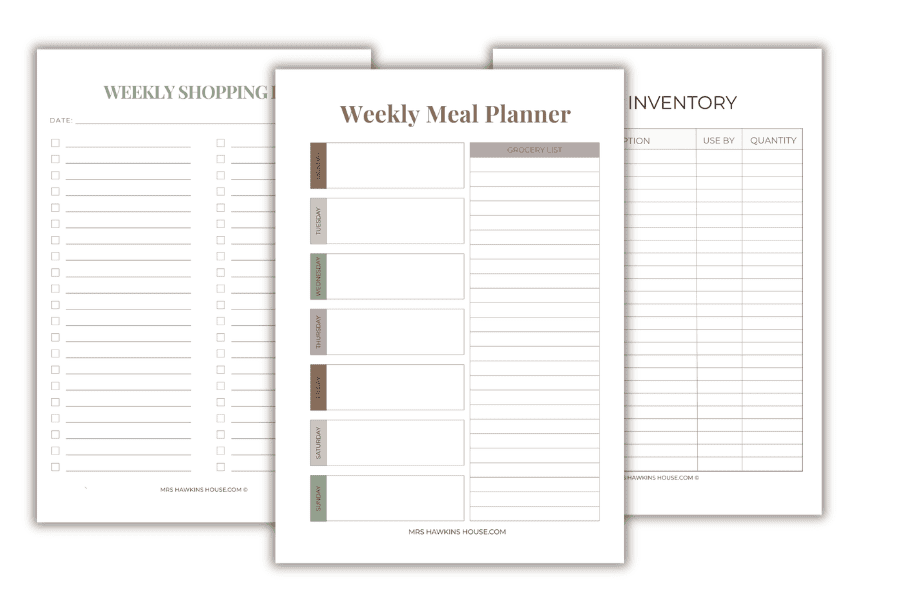
Let me stop you before we move on and reiterate that to save money on groceries, you must plan ahead. I have you covered with this fantastic FREE PDF download meal planner pack in the image below ( these are just 3 of the sheets btw). Go here to grab yours now, you will not regret it.
What We Actually Bought
By the time I was six months into my debt payoff journey, our shopping trolley had become almost boring. I could have walked around Aldi in my sleep and still come home with everything on my shopping list. There was very little variation from week to week, and that’s when I realised there are two common misconceptions about budget shopping.
The first is that cheaper food automatically means heavily processed food. The second is that we need a completely different basket of groceries every single week to eat well. In my experience, neither of those things was true.
Every week I bought foods like potatoes, onions, carrots, cabbage, oats, eggs, milk, flour, butter, rice, pasta, frozen vegetables and whatever fruit offered the best value that week. I chose these foods because they were affordable, versatile and undeniably nutritious.
They’re certainly not glamorous ingredients, but they are incredibly flexible. They form the basis of hundreds of filling family meals. Just take the humble potato, for example. Between us, I’m sure we could easily come up with ten different ways to use one, from breakfast through to dinner.
The more I relied on simple ingredients instead of ready-made products, the more flexibility I had when planning meals. As a result, my grocery basket became cheaper, food waste reduced and I found myself spending far less time wondering what to cook each evening
Small Swaps That Saved Us Money
Sometimes people imagine you need to make huge sacrifices to cut your grocery bill.
In reality, lots of the savings came from small decisions that added up over time.
| Instead of… | We bought… | Why it helped |
| Jelly pots | A block of jelly | Several portions for a fraction of the price |
| Grated cheese | A block of cheese | Better value and lasted longer. |
| Individual cereal pots | Large bags of oats | Filling breakfasts for pennies. |
| Garlic bread | Homemade garlic bread | Simple to make, used up stale bread so almost free! |
| Individual yoghurts | Large tubs of yoghurt | Much lower cost per portion. |
| Ready-made soup | Homemade soup | Often using vegetables on the turn, reducing food waste |
None of these changes transformed our budget on their own but my goodness, together, they made a remarkable difference. I challenge you to do a price comparison like this and see if it saves you even £10 a week.
Did We Feel Deprived?
Honestly? Not really.
Life became a lot simpler in many ways. Of course, there were times when I was sick to death of cooking and craved a takeaway, but we found ways to get over those little humps in the road with homemade pizza and other simple family favourites.
We ate more home-cooked meals around the table, planned before we shopped and wasted very little food. In my experience, there’s a real sense of satisfaction that comes from that. Cakes and sweets became occasional treats instead of everyday purchases, and somehow we enjoyed them even more because they felt special.
I also became far more confident in the kitchen. Learning how to make simple soups, sauces, bread and everyday family meals saved far more money than endlessly hunting for supermarket offers. Looking back, I think the biggest surprise was how calming the whole process became. Simplifying our food and shopping habits took away a lot of the stress I hadn’t even realised I was carrying.
The Biggest Lesson I Learned
The biggest lesson I learned was that reducing a grocery budget isn’t simply about buying cheaper versions of the same food. It’s about changing the way you think about food altogether.
When I stopped relying so heavily on convenience foods and started cooking with simple ingredients, I discovered that good food didn’t have to be expensive.
I’m not suggesting that every family can halve their grocery bill overnight, especially in today’s economic climate. Every household is different, and food prices have risen dramatically since my no-spend year.
What I can say with confidence is that the principles which helped us then still help me today, and I genuinely believe they can help you too.
- Cook from scratch where you can.
- Waste as little food as possible.
- Plan before you shop.
- Buy ingredients instead of ready-made meals.
- Treat convenience as a luxury rather than a necessity.
Those five habits changed far more than our grocery bill.
They helped us pay off debt, gave me confidence in the kitchen and completely changed the way I think about feeding my family.
I’ve thoroughly enjoyed sharing this story with you today. If you’ve found it helpful, I’d love you to join my newsletter below, where I share more practical tips, recipes and simple ways to save money without sacrificing good food
If you’d like to get more inspiration on how to save money join me over on TikTik