How to stockpile food on a budget.

I don’t know about you, but I feel far more settled when I know I have a well-stocked kitchen.
While a well stocked pantry doesn’t just happen overnight, a sensible food stockpile will give you options that you’ll be glad you invested in when life throws a curveball in the future. Over the last few years, all of us have had more than our fair share of curveballs, which is why building a well-stocked kitchen has a priority for me. I have built mine slowly enough to be honest, usually with around £10 a week.
I’d like to be clear before we begin, that this post is not about panic buying or filling cupboards in a frenzy with things you will never use. It is about finding a sensible middle ground between being prepared for life’s up’s and down’s, being realistic about the way that your family actually eats and about the budget you have to dedicate to this mini project.
Food prices have risen exponentially in the last few years and if you’ve felt the pinch at the supermarket in recent times, you are certainly not alone. It is for this reason that I think that stockpiling is quite a sensible thing to do. If we can get some of our preferred brands at discount prices with long expirations dates now, we’ll thank ourselves later in the year when and if prices rise again.
I’m aiming for about three months’ worth of the food, cleaning products and household essentials my family genuinely uses. If this idea appeals to you, don’t feel you have to try to achieve this do not need this overnight. We can build it slowly with £10 a week, £5 a week or whatever the budget allows.
What We’ll Cover in This Post
Let’s make our time together as useful as possible and layout what you’ll be reading about in this post. In this post, we will cover:
- What a sensible food stockpile actually is
- How to build a food stockpile on a budget
- What foods are worth stockpiling
- How to use and rotate your stockpile
- How a stockpile can support meal planning and save money
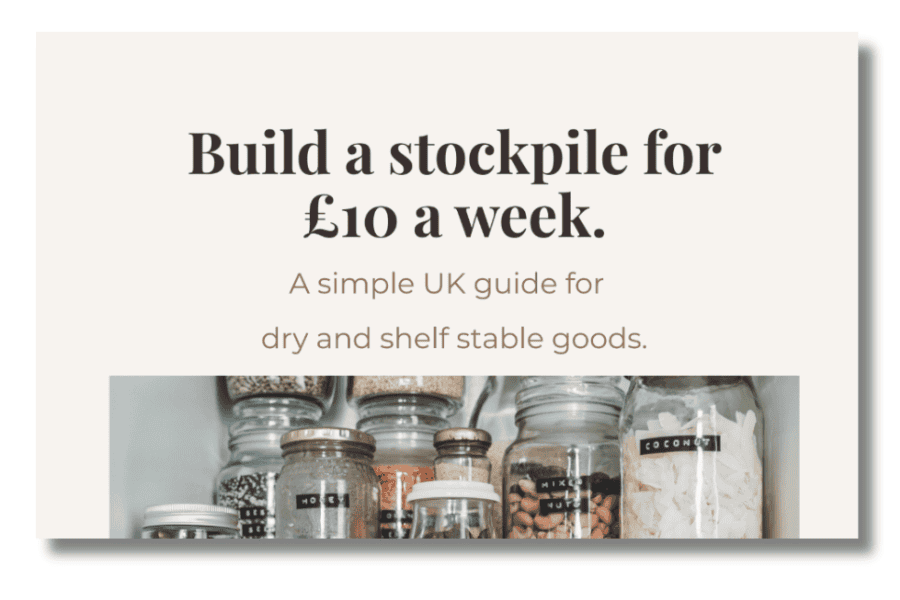
If you want to get into this topic more deeply I have created a free guide, How to Build a Stockpile With £10 a Week. Pop your email address below and I will send it straight to your inbox.
What Is a Sensible Food Stockpile?
A sensible food stockpile is simply a backup of the food and household essentials your family already uses. It is not about panic buying, filling cupboards with random bargains or trying to prepare for every possible disaster. It is about making everyday life a little easier come what may.
Your stockpile might include extra pasta, rice, tins, cereal, tea, coffee, sauces, toiletries, cleaning products or pet food. The exact list will look different in every home because it should be built around the meals you cook, the brands you buy and the things you reach for week after week.
The aim is to create a useful buffer. When money is tight, you are unwell, when the family has ravaged everything in sight, or you simply cannot face another trip to the shop, having familiar basics at home gives you options. You can make a meal, use up fresh food and avoid an expensive top-up shop by having a working food stockpile at home.
Start small and buy what you know you know you will use and don’t forget, check dates and rotate your stock. Use your stockpile as a part of your working pantry and avoiding hoarding for the sake of it.
How to Build a Stockpile on a Budget
With food prices still putting pressure on household budgets, it would be unrealistic to assume everyone has an extra £10 spare money each week. Many families are already stretching their money the best they can to cover the essentials, and if that is where you are right now, building a stockpile may need to wait. The weekly shop comes first!
If you do want to begin, you could start by taking a closer look at your budget. Is there a small amount of money in your budget that you could redirect towards food stockpiling? Are you spending money on something else at the moment that you’d be happy to sacrifice such as a couple of coffees and treats a week? I would avoid trying to cutting back on things your family needs though as that kind of defeats the purpose doesn’t it?
Decide whether there are areas of discretionary spending that you are happy to reduce so you can build a little more security into your kitchen. At one point I analysed my grocery receipts to find that we were spending a fairly hefty percentage on fizzy drinks, snacks and biscuits. It didn’t seem like much each week but it was about 10% of my overall monthly grocery budget (which was around £40 at the time as it turns out!)
Where to keep your stockpile cash?
Once you have chosen an amount, keep it separate. You could use a labelled envelope or old jar to keep your food stockpile budget in. Alternatively you could set up a dedicated digital space in an app such as Revolt. Revolt has little saving pots built in called ‘pockets’ and you could name that pocket “Stockpile”. Whether you use cash or digital money, separating the food stockpile budget like this protects it from everyday spending which can for many of us be unconscious. We want to avoid that unconscious spending hence why we choose a place in particular to keep our food stockpile budget.
How to get the best deal for with your allocated cash?
Then, check supermarket websites, look at prices and offers, and decide whether that deal is genuinely useful for your household. Before buying, check the unit price, the use-by or best-before date, and whether you have space to store it properly. The aim is not to come home with a trolley full of bargains. It is to buy a few useful extras at the right time, then gradually build from there.
What Foods Are Worth Stockpiling?
The best foods to stockpile are the foods your family already eats, that you know how to use, and that you can store safely in your own home. There is no point buying twenty tins of something because it is cheap if nobody likes it or you have no idea what to do with it.
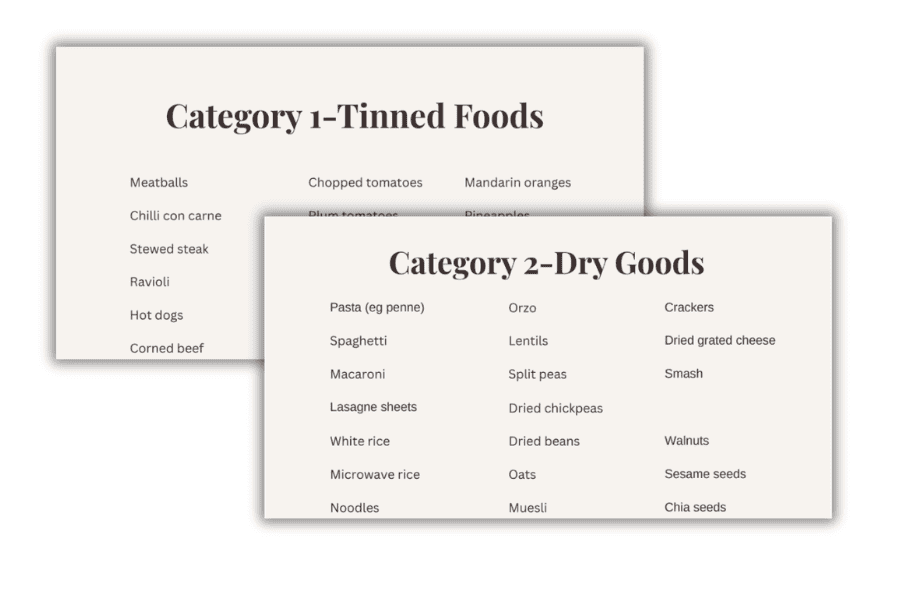
For most households, the best place to start is with long-life, shelf-stable foods. Think dried goods such as pasta, rice, noodles, oats and cereal; tinned foods such as chopped tomatoes, beans, chickpeas, vegetables, tuna and soup; and everyday cupboard items such as stock cubes, tomato purée, sauces, oils, vinegars, herbs and spices.
You may also want to include baking ingredients, drinks such as tea, coffee, long-life milk, bottled water or cordial, and a few household favourites that make simple meals easier. Some families may find it useful to keep a small number of ready-made meals or tinned meal components, such as chilli, meatballs or chicken in sauce. If you do not normally buy them, try one first on an ordinary day. You do not want to discover nobody will eat it when you are relying on it.
Think about your storage space too. A dry cupboard is ideal for flour, cereal, pasta and rice. If your home is damp, very warm or short on space, you may need airtight containers, smaller quantities or indeed to choose a space in your house like under your stairs. The guide breaks these ideas into practical pantry categories, so you can decide what makes sense for your own kitchen. If you haven’t already, be sure to sign up for it now. It is completely free.
How to Use and Rotate Your Stockpile
- I advocate for a working pantry stockpile. This simply means keeping more than you need of the things you already use, then using and replacing them as part of normal life. Your stockpile should not sit forgotten in a cupboard. It should move through your kitchen naturally with the rhythm of your family’s lifestyle.
- Choose a storage space that is dry, clean, easy to access and safe from pets. If you do not have one large pantry area, use a couple of sensible spaces instead. Your everyday food might live in kitchen cupboards, while bulky items such as bottled water, toilet roll, cleaning products or slabs of tins can be stored elsewhere.
- Avoid storing food directly on the floor. Keep it on shelves, in cupboards or in sturdy containers where possible. Water bottles and large packs of toilet roll can be kept on the floor if the area is dry, clean and unlikely to be affected by damp. Before you begin, check for signs of mould, leaks, pests or insects. A stockpile is only useful if it is stored safely.
- Check dates before you buy items and again before you put them away. Put the shortest-dated items at the front and newer items behind them. This means you naturally use the oldest food first.
- A simple list can help, especially if you are storing food in more than one place. Every few months, check your dates, bringing anything that needs using sooner to the front and adding it into your meal plan. If it is something your family still uses, add it back to your shopping list when you have the money to replace it.
That is the whole cycle: buy, store, use, check and replace.
How a Stockpile Can Support Meal Planning and Save Money
Most families eat more or less the same meals on repeat. They may not be exactly the same every week, but there are usually familiar dinners that come around again and again. Spaghetti bolognese, curry, pasta bake, soup, jacket potatoes, wraps, a roast, or whatever your own household relies on.These are your core meals. Once you know what they are, you begin to see the same ingredients appearing over and over again. Pasta, rice, chopped tomatoes, stock, herbs, spices, beans, sauces, flour, oil and a few freezer staples can support a surprising number of meals. Keeping more than enough of those basics at home means meal planning becomes less about starting from scratch and more about choosing from what is already there.
That is where the money-saving part comes in. When you are not under pressure, rushing around the shops or trying to invent dinner at five o’clock, you are more likely to stick to your budget. You can use what you have, make a clear list of what you genuinely need, and avoid those expensive little top-up shops that somehow turn out to be far more expensive than we expected.
This working stockpile pantry concept should not make feeding your family more complicated. It should be about creating a simple systems that takes some of the mental load away. You are building a small, useful store at home around the meals your family already eats, while giving yourself a buffer for busy weeks, tight months and life’s curveballs. don’t forget to grab your free eBook on How To Build A Stockpile of £10 a Week by signing up here.
I hope you enjoyed this post..
and if you did, you should go here next to read about 11 Tips on How to Meal Plan On A Budget
If you’d like to hear more from me about meal planning, saving money on groceries and building a sensible stockpile on a budget, join us over on TikTok and YouTube.